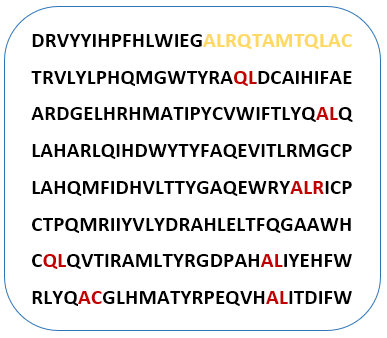
Synthetic Peptide Library
Alan Scientific Inc offers a high-throughput peptide synthesis.
Peptide library is a systematic combination of different peptides in large number. It is widely used in screening, epitope mapping, vaccien development, target validation, and structure-activity research.
96-well peptide synthesizer is used and 96 different peptides can be synthesized simultaneously.
Yield: 1.0~4.0 mg
sequence: 2~30 amino acids
Delivery: around 2 weeks
Average accuracy: >99%
Quality control: HPLC, Mass, Endotoxin Control, TFA Removal Service, Nitrogen Detection Analysis
For special purity, modifications & amount, please feel free to contact us. Our scientific team will support you as soon as possible.
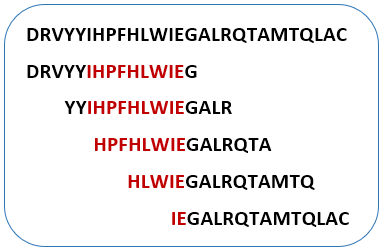
Overlapping Peptide Library: Breaking the naturual protein or peptide into many equal length overlapping fragment and it is used for linear, continuous T-cell epitope determination and epitope mapping.
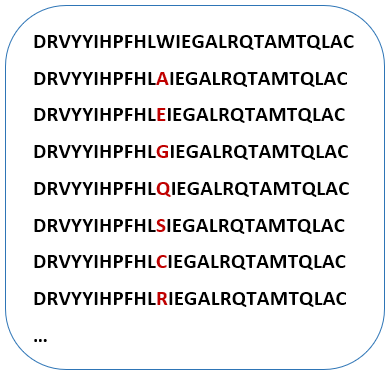
Positional Peptide Library: a selected position in a peptide sequence is systematically replaced with different amino acid in order to show the effect on the substitute amino acicd at certain position.
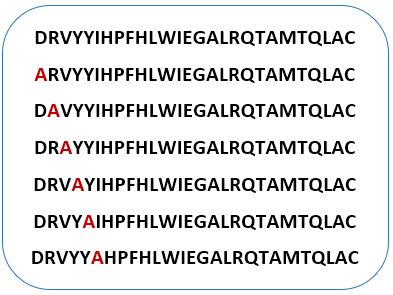
Alanine Scanning Peptide Library: it is used to identify residues that play a role in the activity of a peptide. The effect of alanine substitution on the overall peptide activity is used to determine the importance of each individual residue.
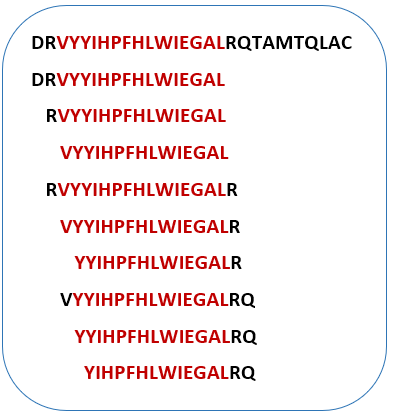
Truncated Peptide Library: it is constructed by systematically removing flanking sequences of an active sequence core. The purpose is to identify the smallest sequence fragment needed for activity. The construction of the truncation library could also be centered around these core amino acid residues if the knowledge of the positions of core residues elucidated via Alanine Scanning Peptide Library.
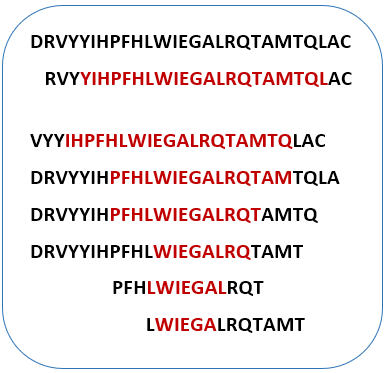
T-cell Truncated Peptide Library: to test all possible T-cell epitopes across a protein of interest. Once identified, the sequences can be used to build the development of targeted drugs or engineer specialized T cells.
Scramble Peptide Library: It is designed by carrying out permutation on the original sequence of peptide. It could show all poosible alternatives and represents the highest degree of variability for peptide library.