Peptide Synthesis Overview
Introduction
Proteins are present in every living cell and possess a variety of biochemical activities. They appear as enzymes, hormones, antibiotics, and receptors. They compose a major portion of muscle, hair, and skin. Consequently, scientists have been very interested in synthesizing them in the laboratory. This interest has developed into a major synthetic field known as Peptide Synthesis. The major objectives in this field are four-fold:
To verify the structure of naturally occurring peptides as determined by degradation techniques.
To study the relationship between structure and activity of biologically active protein and peptides and establish their molecular mechanisms.
To synthesize peptides that are of medical importance such as hormones and vaccines.
To develop new peptide-based immunogens.
Solid-Phase Peptide Synthesis (SPPS)
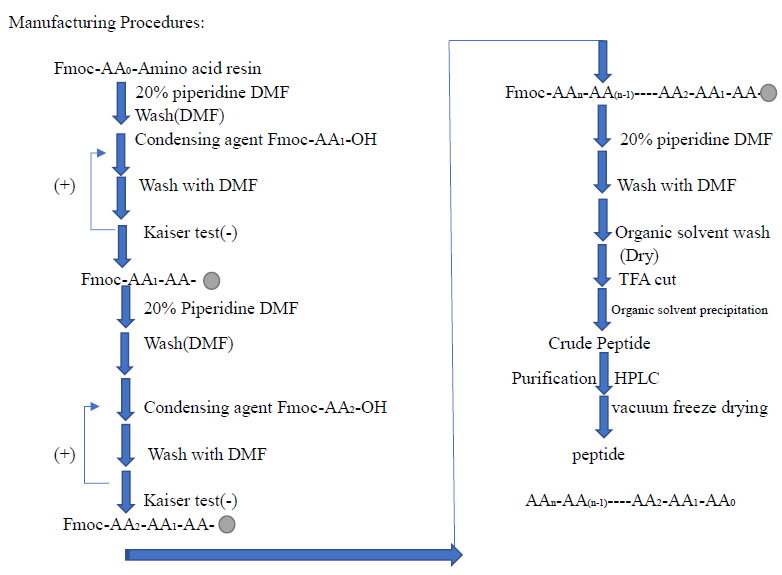
SPPS is the industry norm for small and meso-scale production of peptides. In SPPS, the first amino acid and nascent peptide is C-terminally linked to a solid-phase resin; typically, polystyrene or polyacrylamide. This process of physically linking the peptide to solid-phase support gives rise to SPPS’s primary advantage: the capacity to limit side-reactions by washing reactants and waste products during every step of extension.
The solid support is a synthetic polymer that bears reactive groups such as -OH. These groups are made so that they can react easily with the carboxyl group of an N-a-protected amino acid, thereby covalently binding it to the polymer. The amino protecting group (X) can then be removed and a second N-a-protected amino acid can be coupled to the attached amino acid. These steps are repeated until the desired sequence is obtained. At the end of the synthesis, a different reagent is applied to cleave the bond between the C-terminal amino acid and the polymer support; the peptide then goes into solution and can be obtained from the solution.