AI-Driven Cyclic Peptide Design and Optimization Platform
a. Product Overview
This product is an integrated, cutting-edge platform for cyclic peptide optimization and de novo design, powered by artificial intelligence and computational structural biology. The platform, HighFoldAI, accepts an initial core peptide sequence (e.g., a binding motif) and, through fully automated AI iterative generation and physical modeling, delivers a series of novel cyclic peptide candidate molecules within minutes. These candidates exhibit optimized physicochemical properties and predicted structural stability, greatly accelerating the progression from hit identification to lead optimization.
The core technology integrates next-generation protein structure prediction (AlphaFold2, AlphaFold2 PTM, AlphaFold2 Multimer V1~V3), AI-driven intelligent sequence generation (C2C Model), and high-precision property evaluation into a fully closed-loop design-validation workflow. Compared to traditional phage display or limited synthetic library screening, this platform offers three key advantages:
Innovation: The AI explores sequence spaces beyond human experience to generate unique cyclic structural motifs with strong intellectual property potential.
Systematic Capability: Enabling multi-objective parallel optimization of performance indicators (e.g., stability, solubility, molecular weight).
Predictability: Providing comprehensive virtual validation from atomic-level 3D structures to physicochemical property scoring, significantly increasing experimental success rates while reducing development costs.

b. Core Advantages of HighFold-C2C
Requirement Analysis & Input Preparation:
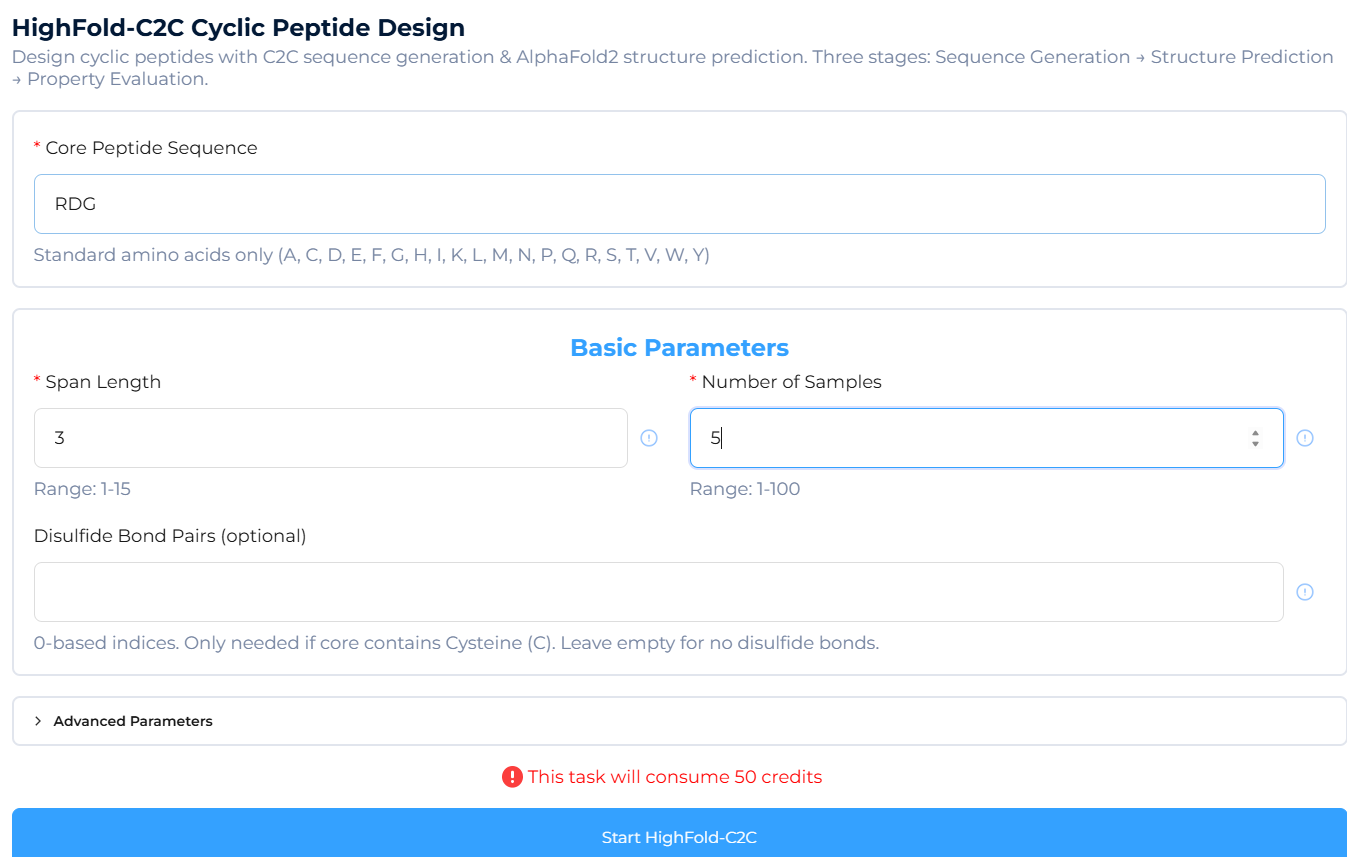
The client provides a core peptide sequence (single-letter amino acid code) and defines the desired loop size (Span Length). The platform automatically processes the input, establishing a baseline for the cyclic generation process.Structure-Guided Sequence Generation:
The platform's core workflow initiates. First, it utilizes the C2C generative model to perform large-scale, intelligent redesign of the peptide sequence based on the specified Span Length. This step generates multiple novel candidate sequences that maintain the core motif while optimizing the surrounding residues for cyclization stability.High-Precision Structural Prediction & Screening:
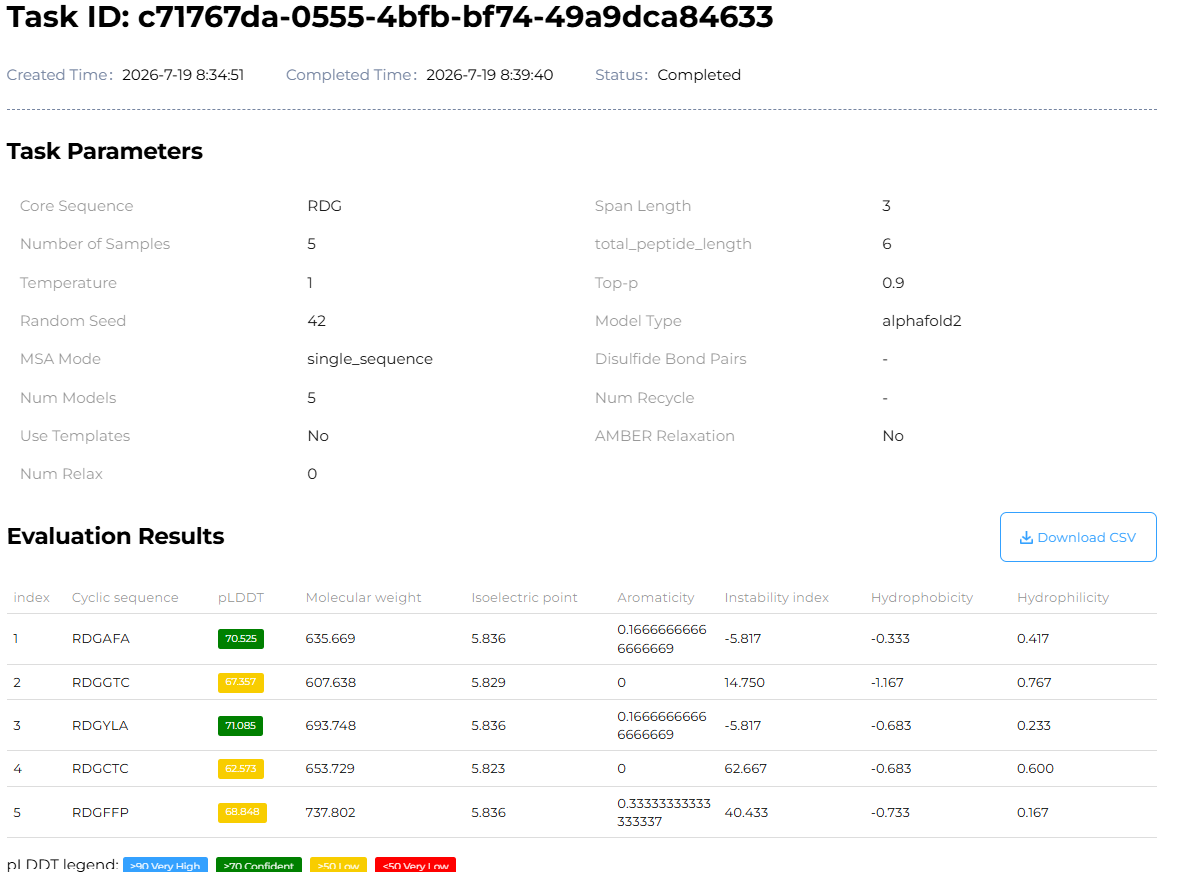
For the generated candidate sequences, the platform employs (AlphaFold2, AlphaFold2 PTM, AlphaFold2 Multimer V1~V3) for rapid, precise structure prediction. It calculates the pLDDT confidence score to assess structural reliability. Simultaneously, the system computes comprehensive physicochemical metrics, including Molecular Weight, Isoelectric Point, Aromaticity, Instability Index, and Hydrophobicity. All candidate peptides are comprehensively ranked and filtered based on these multi-dimensional metrics.In-Depth Analysis & Results Delivery:
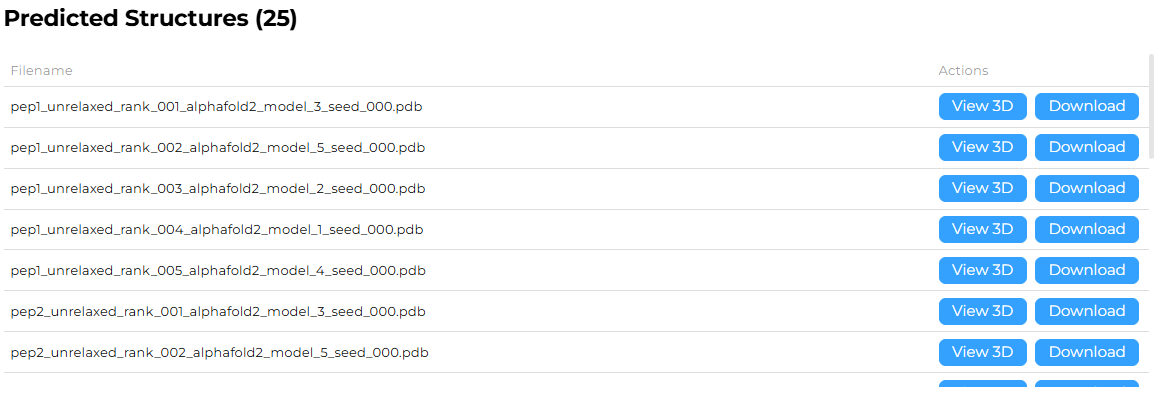
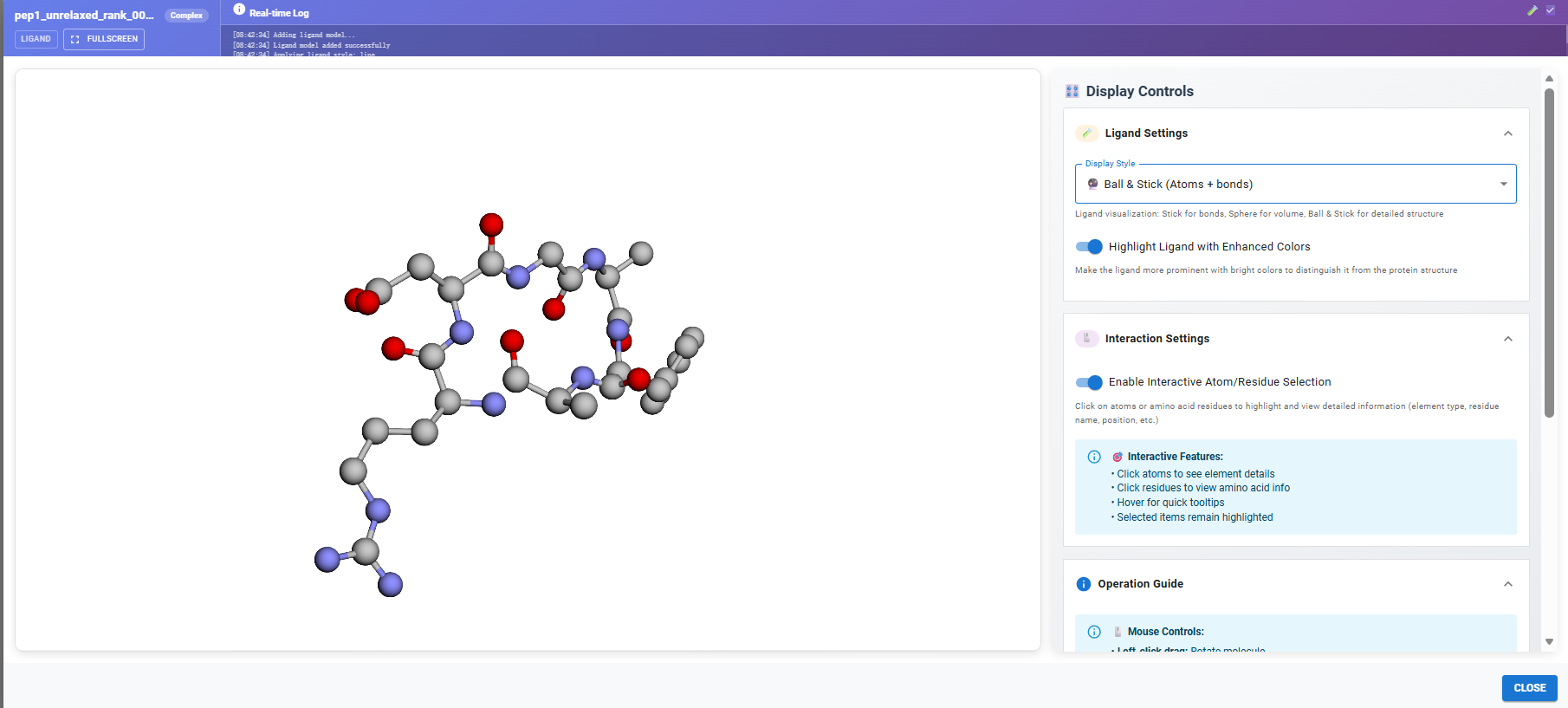
The platform delivers a detailed report for top-ranked candidate peptides (typically the Top 5-20), supported by downloadable 3D structure files (.pdb) and a built-in 3D viewer. It visually highlights the cyclic conformation and generates a comprehensive property prediction CSV, supporting confident, data-driven decision-making in downstream synthesis and testing.
c. For Whom and What Problems Does It Solve?
Challenges
Traditional peptide discovery relies on natural peptide libraries or phage display, which suffer from limited diversity and poor in vivo stability of linear peptides.
Linear peptides are highly flexible, leading to weak binding ability and rapid degradation in biological environments.
Designing cyclic peptides manually is difficult due to the complex relationship between sequence, ring size (span length), and structural stability.
High failure rates in synthesis due to poor solubility or instability.
Solutions
The platform can generate a series of stable, cyclic candidate molecules with intellectual property novelty for specific core motifs within minutes to hours, shortening the early discovery cycle from months to days.
By enforcing cyclization constraints during generation, it produces rigid scaffolds with potentially higher affinity and metabolic stability.
d. Typical Workflow
Input: Submit the Core Peptide Sequence (e.g., RGD) and define the Span Length (loop size).
Design: The C2C workflow rapidly generates a diverse pool of cyclic peptide sequences (e.g., 20 samples) while simultaneously predicting their 3D structures using AlphaFold2, AlphaFold2 PTM, AlphaFold2 Multimer V1~V3.
Optimization: Users can refine results by adjusting Advanced Parameters such as Temperature, Top-p sampling, and enabling AMBER Relaxation for energy minimization.
Output: Obtain a series of virtually validated cyclic peptide candidates, complete with pLDDT scores, physicochemical property reports, and downloadable 3D structure files (.pdb) for subsequent synthesis and testing.
e. Cost
Each optimization project costs 50 credits.
f. Showcase
Other AI-Powered Quantum Computing Tool Platforms:
AlanMolecularAI™: AI-Quantum Computing-Powered Online Optimization Platform for Small Molecules, integrated with proprietary molecular fragmentation technology, enables multi-round ADMET model screening and accelerates the early discovery and optimization of small molecules
AlanDockAI™: Online Tool for Automatic Small Molecule-Target Docking with Proprietary Algorithms
AlanPepAI™: Online Platform for Linear Peptide Sequence Optimization
To Get More Credits or View Pricing Plans:
Log in and go to My Account > AIPower Platform > Add Credits to Your Account
For Peptide Synthesis Service:
Please click here Peptdie Synthesis