AI Peptide Optimization
AlanPepAI™ is an AI-assisted platform for linear peptide design and sequence optimization. It combines structure-guided peptide generation, peptide–protein structural modeling, molecular docking, and multi-parameter candidate ranking to help researchers prioritize promising peptide sequences before experimental synthesis and validation.
AlanPepAI™ can be used to optimize an existing peptide sequence or generate and evaluate new peptide candidates using structural information from a target protein.
The goal is to reduce a large virtual design space into a focused set of peptide candidates for synthesis and experimental testing.
What Can AlanPepAI™ Do?
| Research Need | AlanPepAI™ Approach | Output |
| Optimize an Existing Peptide | Explore sequence variants around a starting peptide | Ranked optimized peptide candidates |
| Design New Peptide Candidates | Generate peptide sequences using target structural information | Novel candidate peptide sequences |
| Evaluate Peptide–Target Binding | Model and dock peptides against a target protein | Predicted peptide–protein complexes |
| Analyze Molecular Interactions | Evaluate predicted peptide–target interfaces | Key contacts and interaction patterns |
| Compare Multiple Candidates | Combine structural, docking, sequence, and property information | Prioritized candidate ranking |
| Select Peptides for Testing | Shortlist computationally prioritized candidates | Sequences ready for peptide synthesis |
AlanPepAI™ Workflow
1. Define the Target and Starting Peptide
A project begins with available structural and sequence information. Users can provide a target protein structure and, for peptide optimization projects, an existing linear peptide sequence.
Additional information such as a known or proposed binding region and the desired optimization objective can also be incorporated into the project.

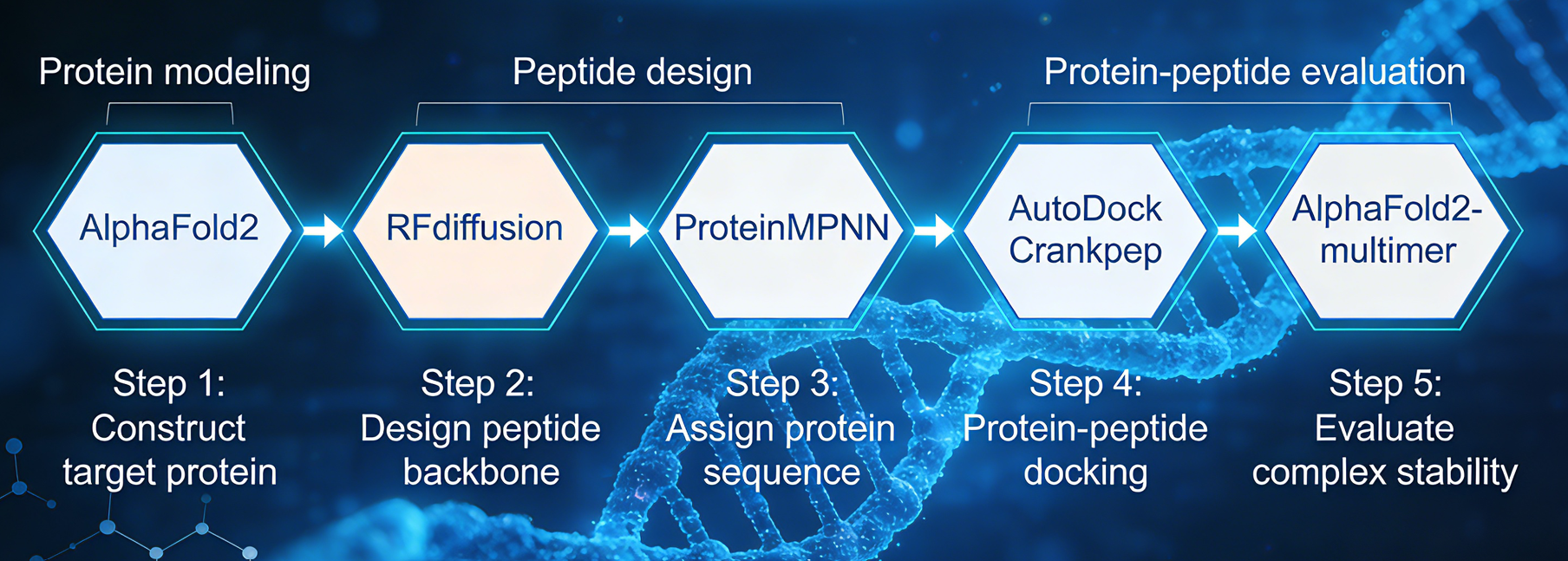
2. Structure-Guided Peptide Design
AlanPepAI™ explores alternative peptide designs according to the structural environment of the target and the selected optimization strategy.
Structure-guided methods such as RFdiffusion and ProteinMPNN can be incorporated into the workflow to generate peptide backbones and alternative amino acid sequences based on structural context.

3. Peptide–Protein Structural Modeling
Generated peptide candidates are evaluated in the context of the target protein. Structure-prediction and complex-modeling methods can be used to examine whether candidate sequences are structurally compatible with the proposed peptide–target interaction.
4. Peptide–Protein Docking
AlanPepAI™ incorporates peptide-focused docking workflows, including AutoDock CrankPep (ADCP), to explore potential peptide binding modes against the target structure.
Docking provides predicted peptide conformations, binding poses, and interaction-related information that can be used as part of candidate comparison.
5. Multi-Parameter Candidate Ranking
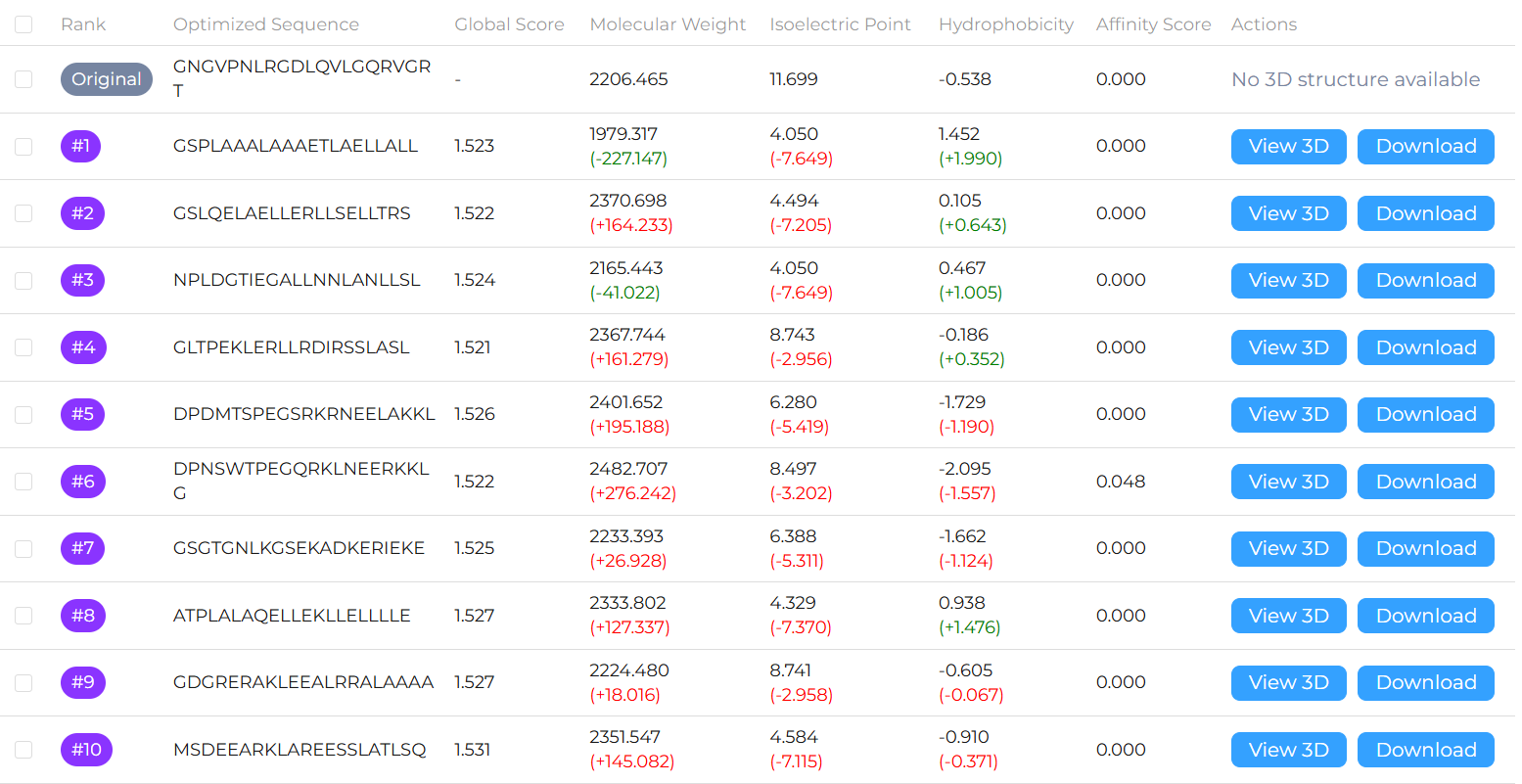
AlanPepAI™ compares peptide candidates using multiple computational parameters rather than relying on a single score.
Depending on the workflow, candidate information may include:
Optimized peptide sequence
Global ranking score
Molecular weight
Isoelectric point
Hydrophobicity
Docking or interaction-related scores
Predicted structural information
The result is a prioritized set of candidates that can be selected for downstream peptide synthesis and experimental validation.
Technologies Integrated in AlanPepAI™
| Technology | Role in AlanPepAI™ |
| AlphaFold-Based Modeling | Protein and peptide–target structural modeling |
| RFdiffusion | Structure-guided backbone and candidate design |
| ProteinMPNN | Structure-conditioned amino acid sequence design |
| AutoDock CrankPep (ADCP) | Flexible peptide–protein docking |
| Complex Structural Modeling | Evaluation of selected peptide–target complexes |
| Interaction & Property Analysis | Comparison and prioritization of peptide candidates |
What Does AlanPepAI™ Deliver?
| Deliverable | Description |
| Candidate Peptide Sequences | Generated or optimized linear peptide sequences |
| Candidate Ranking | Comparative prioritization of peptide candidates |
| Predicted Complex Structures | 3D models of selected peptide–target complexes |
| Docking Results | Predicted peptide binding poses and computational scores |
| Interaction Analysis | Evaluation of selected peptide–target contacts and interface residues |
| Property Predictions | Selected sequence and physicochemical descriptors |
| Candidate Shortlist | Prioritized peptides for synthesis and experimental testing |

Applications of AlanPepAI™
Existing Peptide Optimization
Start from an existing peptide sequence and explore alternative amino acid combinations that may improve predicted target interactions or other selected design properties.
Target-Based Peptide Design
Use structural information from a protein target to generate and evaluate potential linear peptide binders.
Peptide Candidate Prioritization
Evaluate a larger set of computationally generated candidates and select a smaller number of peptides for experimental synthesis and testing.
Structure–Activity Exploration
Investigate how sequence substitutions may influence predicted peptide structure, target interactions, and selected physicochemical properties.
From AI Peptide Design to Experimental Synthesis
AlanPepAI™ connects computational peptide design with Alan Scientific's Custom Peptide Synthesis capabilities.
Computationally prioritized candidates can move directly into peptide synthesis for experimental evaluation.
Target / Starting Peptide → AI Design → Structural Evaluation → Candidate Ranking → Peptide Synthesis → Experimental Validation
This integrated workflow helps researchers move from virtual peptide design to physical candidate testing while maintaining continuity between computational and experimental project requirements.
Understanding AlanPepAI™ Predictions
AlanPepAI™ is a computational peptide design and candidate-prioritization platform.
Predicted structures, docking poses, interaction scores, physicochemical properties, and candidate rankings are computational estimates. They should not be interpreted as experimental measurements of binding affinity, biological activity, stability, or efficacy.
Experimental synthesis and biological validation remain necessary to confirm peptide performance.
Related Alan Scientific AI Platforms
AlanPepAI™ is part of Alan Scientific's growing suite of AI-assisted molecular design and drug-discovery technologies.
AlanMolecularAI™
AI-assisted small-molecule generation and molecular optimization.
AlanDockAI™
Automated molecular docking and structural interaction analysis.
HighFoldAI™
AI-assisted cyclic peptide design and structural evaluation.
For additional technical discussion of computational peptide design, explore our AI Peptide Design & Optimization Knowledge Center.
Start an AlanPepAI™ Project
To begin a peptide design or optimization project, provide the available target structure, starting peptide sequence, binding-site information, and optimization objective.
AlanPepAI™ can then generate, evaluate, and prioritize peptide candidates for downstream synthesis and experimental validation.
Start AlanPepAI™
1. Purpose
This document outlines the confidentiality obligations for users of the Alan Scientific platform.
2. User Confidentiality Undertaking
You acknowledge that the Alan Scientific platform, including its AI models, algorithms, software, and
interfaces, constitutes proprietary and confidential information. You agree not to disclose, reverse
engineer, or misuse these elements.
3. Our Data Handling Commitment
We will treat the non-public data you input into the platform as confidential. This data will be used
solely to provide the service to you. We implement industry-standard security measures to protect your
data.
4. Permitted Use of Data
We retain the right to use anonymized and aggregated data to train and improve our AI models. This
process
ensures your confidential information cannot be identified.
5. Prohibited Data
You are prohibited from uploading protected health information (PHI) or other specially categorized
personal data. The service is intended for research data only.
6. Liability
Alan Scientific's liability regarding data confidentiality is governed by our Terms of Service. We are
not
liable for indirect or consequential damages.
7. Contact
For questions regarding this policy, contact: [[email protected]].